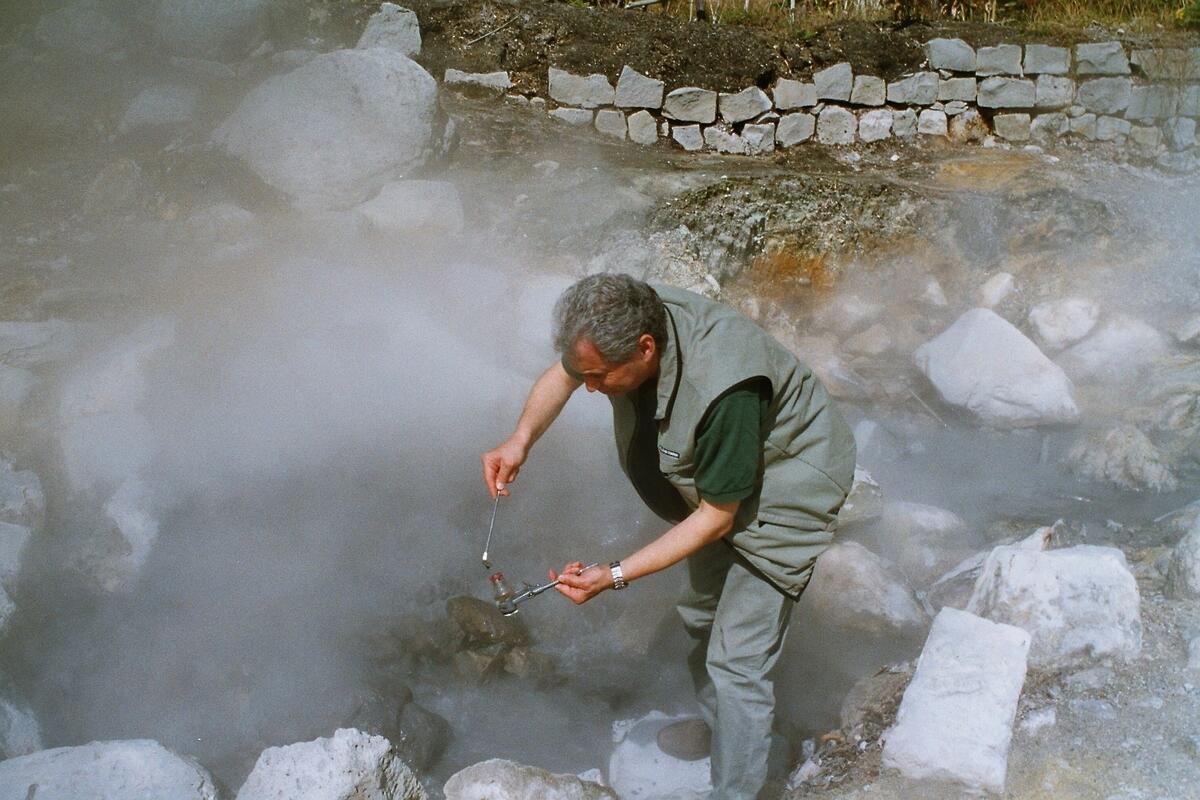
Goal of the project of the TU Hamburg-Harburg was the environmentally friendly production of amino- and carbon acids from preliminary stages (amides) by using newly discovered amid-converting enzymes (amidases) out of extremophile microorganisms. Extremophile microorganisms are found in most inhospitable habitats (volcanos, hot springs, salt lakes) and they grow optimally at very extreme temperatures (<10 °C and >70 °C), pH-values (
pH 8) and salt concentrations
(30 % of salt). In contrast to conventional amidases, the enzymes from extremohpile microorganisms are charaterised through a high stability against high temperatures and other destructive influences. In addition, the new amidases have wide pH-spectra that cover especially also the sour and neutral area.
Amidases from thermophilic bacteria were purified and biochemically characterised. Result: The enzymes work optimally at 70 °C under conditions, where "normal" enzymes are already inactive. Furthermore the project partners were successful in producing large quantities of the thermoactive enzymes in suitable hot organisms. The way is paved for testing the newly discovered biocatalysts to be used in the non-polluting synthesis of defined organic acids.
Projektziel:
Biocatalysis with robust enzymes
Projektträger:
Technische Universität Hamburg-Harburg
Technische Mikrobiologie
Prof. Dr. Dr. h. c. Garabed Antranikian
Kasernenstraße 12
21073 Hamburg
Telefon:
+49-40-42878-3117
Fax:
+49-40-42878-2582
URL:
www.technical-microbiology.de
E-Mail:
antranikian@tuhh.de