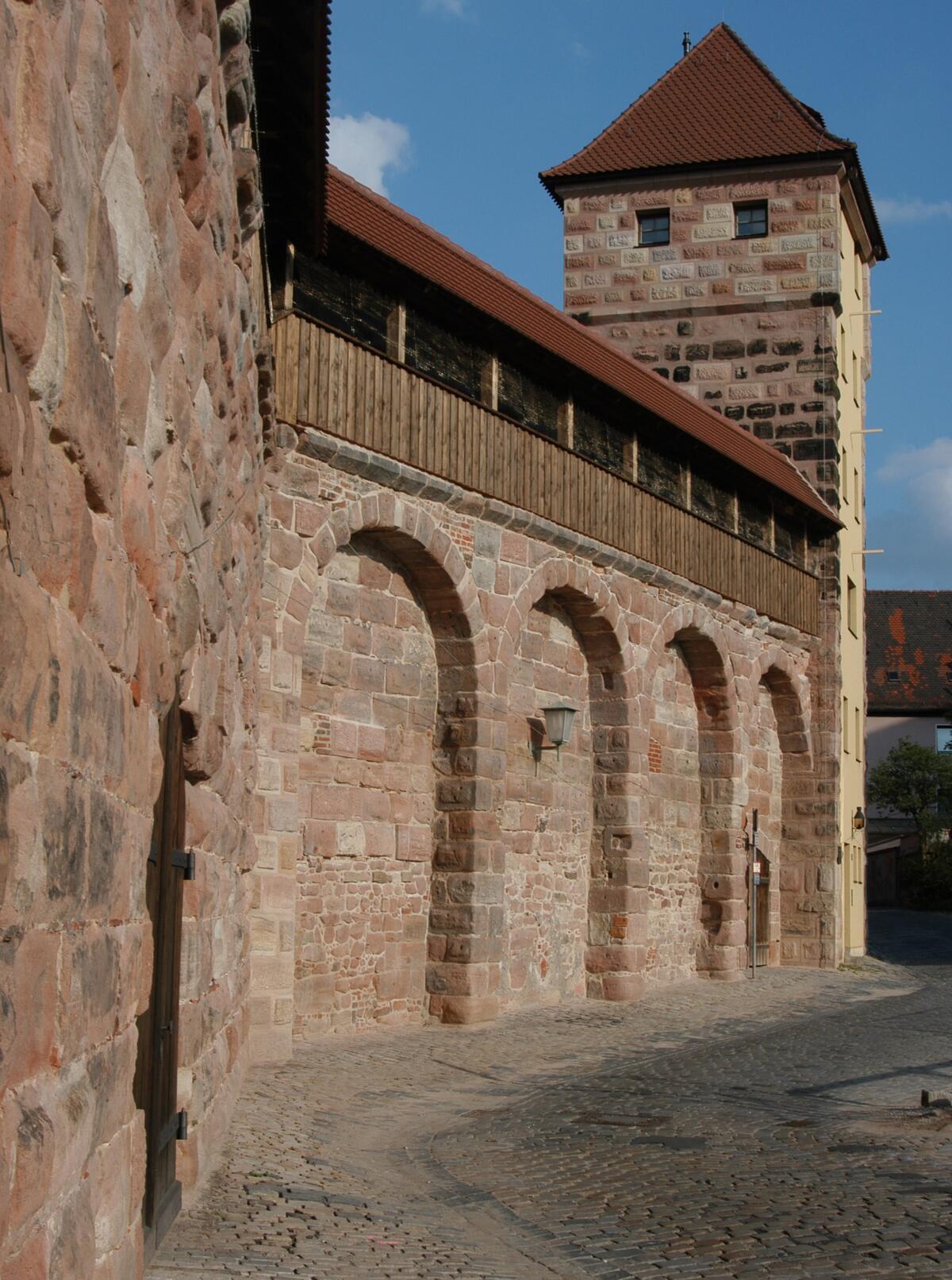
The wall, whose eldest parts are from the 14th century, is strongly damaged by environmental influences. Street salt penetrated deeply into the sandstone and threatens to destroy it. The decrease of the sandstone partly endangers the statics of the historic construction.
In fighting against the salt, practicians and natural scientists jointly developed a useful compress specifically tested on the local sandstone. In strongly concerned wall sections up to two kilograms of salt per cubic meter were extracted from the stone. The compress can be applied by using a plastering machine - a work relief, that paid off economically and eased the following preservation. The conservation method follows the silicic acid ester modul system. According to the stone condition, different substances were used. With success: Only few stones could no more being rescued and had to be either supplemented or replaced.
Because statics and construction of the wall had suffered in some areas over the decades, the wall had to be stabilized by a self-supporting nail construction. Thus changes at the wing assembly could be avoided. In order to prevent from moisture, a roof and an open furrow were built, the latter deriving surface water like rain and snow. Meanwhile, the city of Nuremberg uses the procedure within a big redevelopment measure at another segment of the Nuremberg city wall.