Ecological biomaterials

The bacterial metabolic product Poly-(R)-3-hydroxy-butyrate (PHB) can be converted into plastics.

Umweltgerechte Biomaterialien
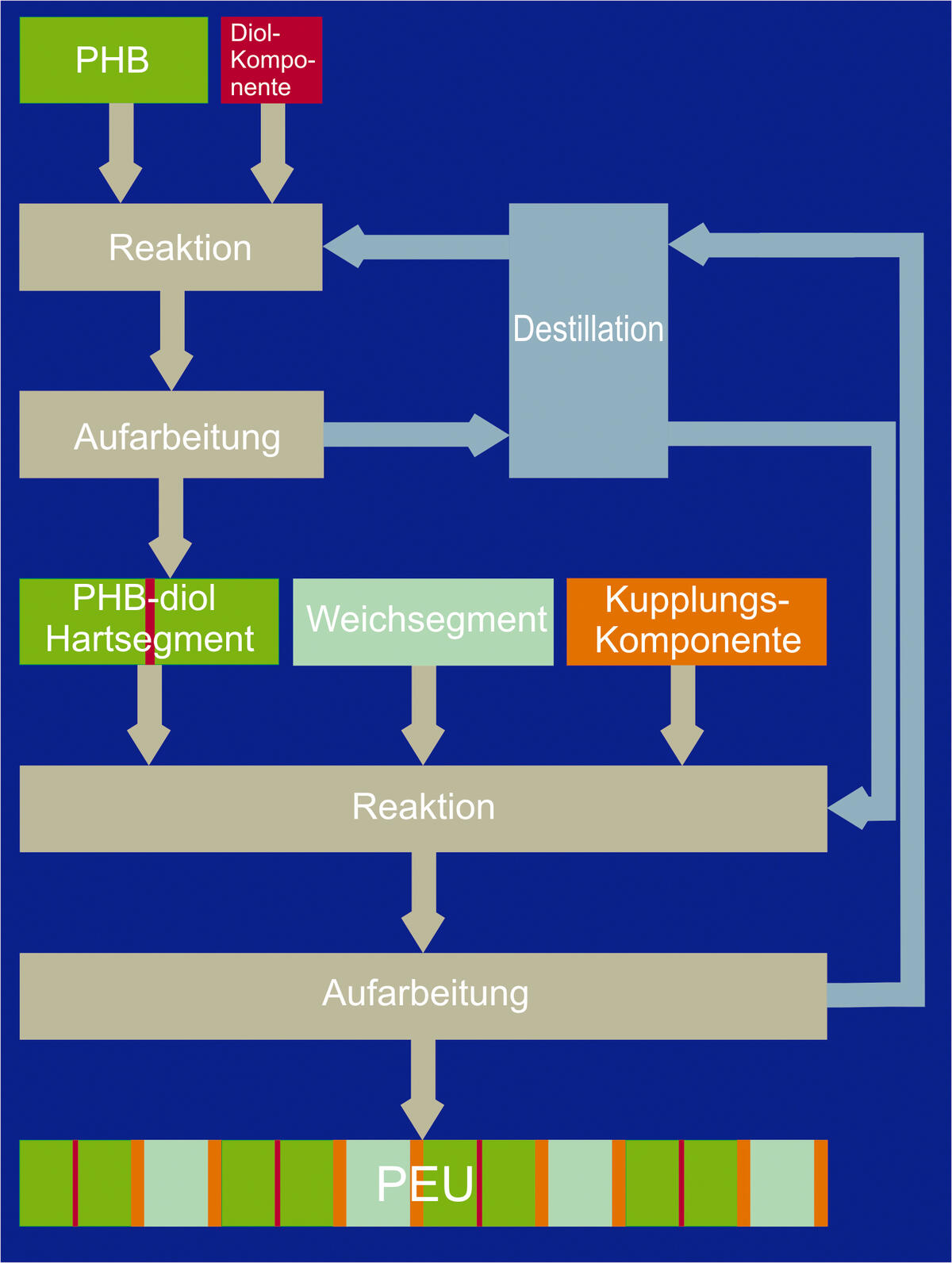
Schema: Production of PEU from PHB
Download
However, it is difficult in processing, brittle and nontransparent. The team Chemical Functions in Biosystems of the Ulm University succeeded in remedying these disadvantages. On the basis of PHB, polyesterurethan (PEU) is produced in a two-stage process. This ductile-elastic material is robust in use and biologically fast degradable. However, its production is still too expensive for many applications.

Regrowing plastics
Producible at less costs, so-called »blends« are a recommendable option. This mixture from PEU and recycling material (i.e. waste from viscose silk) or natural raw materials like flax, hemp or wood flour yields a hard, ductile and impact-resistant material.
Products from PEU and blends are various adhesives, packaging materials, die cast components, foils or plates. Since based on biomaterials, they can be recycled in respect to energy and material.